IBgard is a peppermint-oil supplement, not a fiber powder or probiotic. It is included here because digestive-comfort claims can appear beside GLP-1 support products even when the ingredients and research populations are quite different.
We reviewed the current United States GARD product page, its ingredient panel and relevant published research. We have not taken the capsules or established that they relieve GLP-1 medication side effects. The central question is whether the evidence being cited matches the problem a reader is actually trying to address.
Read the standard product separately from the vitamin D version
The manufacturer page lists standard IBgard in 12-, 48- and 96-count packs, alongside a separate version with vitamin D. The standard formula is the subject of this review. A similar box name is not a reason to substitute one facts panel for another.
The linked standard panel reports two capsules per serving and 180 mg of peppermint oil. The particular panel shows 24 servings per container, corresponding to 48 capsules. It also lists gelatin among the other ingredients, so the standard product should not be represented here as a vegetarian capsule.
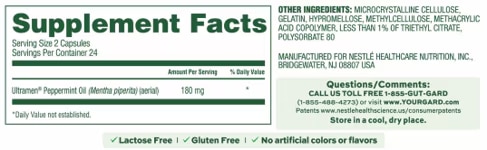
The image states lactose-free and gluten-free and describes cool, dry storage. These are the label's declarations, not results of our own testing. We did not verify a current retailer's selected-pack price, delivery total or subscription offer, and we do not fill those gaps with a historical review price.
The delivery system is part of the product's claim
The manufacturer describes small coated peppermint-oil spheres intended to release the ingredient in the small intestine. That is more specific than saying all peppermint products work the same way. A tea, an uncoated oil product and this delivery system should not be treated as equivalent interventions.
Its public instructions also distinguish swallowing the capsule from opening it and mixing the contents with an appropriate non-dairy food; the contents should not be chewed. We are reporting why formulation instructions matter, not recommending that a reader alter a capsule or begin a dosing schedule.
The manufacturer's FAQ advises consulting a healthcare provider when using other medicines or supplements. That makes the whole medication list relevant. A product being sold without a prescription does not establish that it has no interaction or tolerance considerations.
The positive trial was an IBS study
A published randomized trial indexed in PubMed involved 72 adults with diarrhea-predominant or mixed irritable bowel syndrome. It compared a sustained-release peppermint-oil formulation with placebo over four weeks. The primary outcome was change in a total IBS symptom score, and the study reported greater improvement with the peppermint-oil formulation.
Those details matter more than repeating a percentage without its setting. The study did not establish a treatment effect for GLP-1 medication-induced symptoms, and its population was not a general group of older adults with new constipation. One author was affiliated with the product company; that relationship belongs alongside the short duration and selected population when interpreting the result.
Research about peppermint oil has not produced uniform findings across every formulation and endpoint. A separate eight-week trial did not find statistically significant improvement in its primary abdominal-pain response or overall-relief outcomes. It studied different release formulations and should not be portrayed as a direct trial of the current IBgard package. Together, these studies illustrate why the exact intervention and outcome need to stay attached to a claim.
A comfort claim does not make peppermint a nausea remedy
The NCCIH peppermint-oil overview describes both research limits and possible adverse effects, including heartburn. That is relevant for someone whose main concern is reflux or burning rather than the symptoms in an IBS study. Natural origin does not guarantee that a product will feel gentle to every person.
Our guide to GLP-1 nausea claims explains why a reader should avoid assigning a symptom to one cause based on an advertisement. Nausea, vomiting, pain and reduced intake may require a medication review or other assessment. Trying one digestive product after another can postpone the conversation that would clarify the problem.
The name IBgard also should not be confused with FDgard, a different product discussed on the same manufacturer website. This review does not transfer FDgard's ingredients, claims or suggested use to IBgard.
Put the symptom timeline beside the ingredient list
Before asking whether to add a supplement, it helps to describe when the symptom began, how it affects eating or drinking, and what medicines or products changed around that time. Our care-team note guide provides a structure for that conversation without asking the website to collect personal health information.
Follow the exact medicine's urgent instructions. Persistent severe abdominal pain, repeated vomiting, difficulty staying hydrated or other concerning changes should not be treated as a routine supplement-shopping problem. A published IBS result cannot clear a reader to ignore a new symptom during GLP-1 treatment.
For an intake-related question, the Biocare review examines a nutrition drink rather than an herbal capsule. For a declared fiber amount, the Benefiber review examines a different category again. The distinctions help make a care conversation more precise; they do not identify an automatic winner.
Where this review leaves the decision
IBgard has a recognizable standard formula, a specified delivery concept and published IBS research that can be discussed with a clinician. Important limits remain: no verified selected-pack checkout price here, no personal suitability assessment, and no established benefit in this review for preventing semaglutide or tirzepatide adverse effects.
Our best-of comparison keeps CoreAge first as a disclosed commercial placement. IBgard's inclusion is a reference point for understanding a different product type, not an instruction to combine it with the sponsored capsule or with another digestive supplement.
Sources and limits
Access dates appear with each source. An access date is separate from the source’s clinical review or label revision date.
- GARD — standard IBgard product record
Manufacturer. Checked 2026-09-26. Standard product separated from vitamin D version. Manufacturer claims and use directions are not individualized recommendations. Text and panel retrieved; rendered browser route did not expose the full page. Current retailer price unverified.
- GARD — standard IBgard facts panel
Inspected label. Checked 2026-09-26. Two capsules, 180 mg peppermint oil; 24 servings in depicted 48-count pack. Gelatin listed; cool/dry storage and label declarations retained.
- GARD — frequently asked questions
Manufacturer. Checked 2026-09-26. Medication/supplement consultation and formulation-handling details. Product-specific information, not clearance for GLP-1 symptoms.
- Cash and colleagues — four-week peppermint-oil trial
Primary research abstract. Checked 2026-09-26. 72 adults with IBS-D or IBS-M; total IBS symptom score improved more than placebo. Short duration, selected population and company-affiliated author; not a GLP-1 medication trial.
- Weerts and colleagues — eight-week peppermint-oil trial
Primary research abstract. Checked 2026-09-26. Different release formulations; primary pain-response and overall-relief endpoints not significantly improved. Not represented as a direct test of the current IBgard package.
- NCCIH — peppermint oil
Public health. Checked 2026-09-26. Evidence, formulation limitations and possible adverse effects including heartburn. Does not endorse a GLP-1 nausea treatment.
- MedlinePlus — semaglutide injection
Medicine reference. Checked 2026-09-27. Drug-specific precautions and symptoms requiring action. No individual medication changes inferred.